Fastest-Growing Job Sectors in Germany

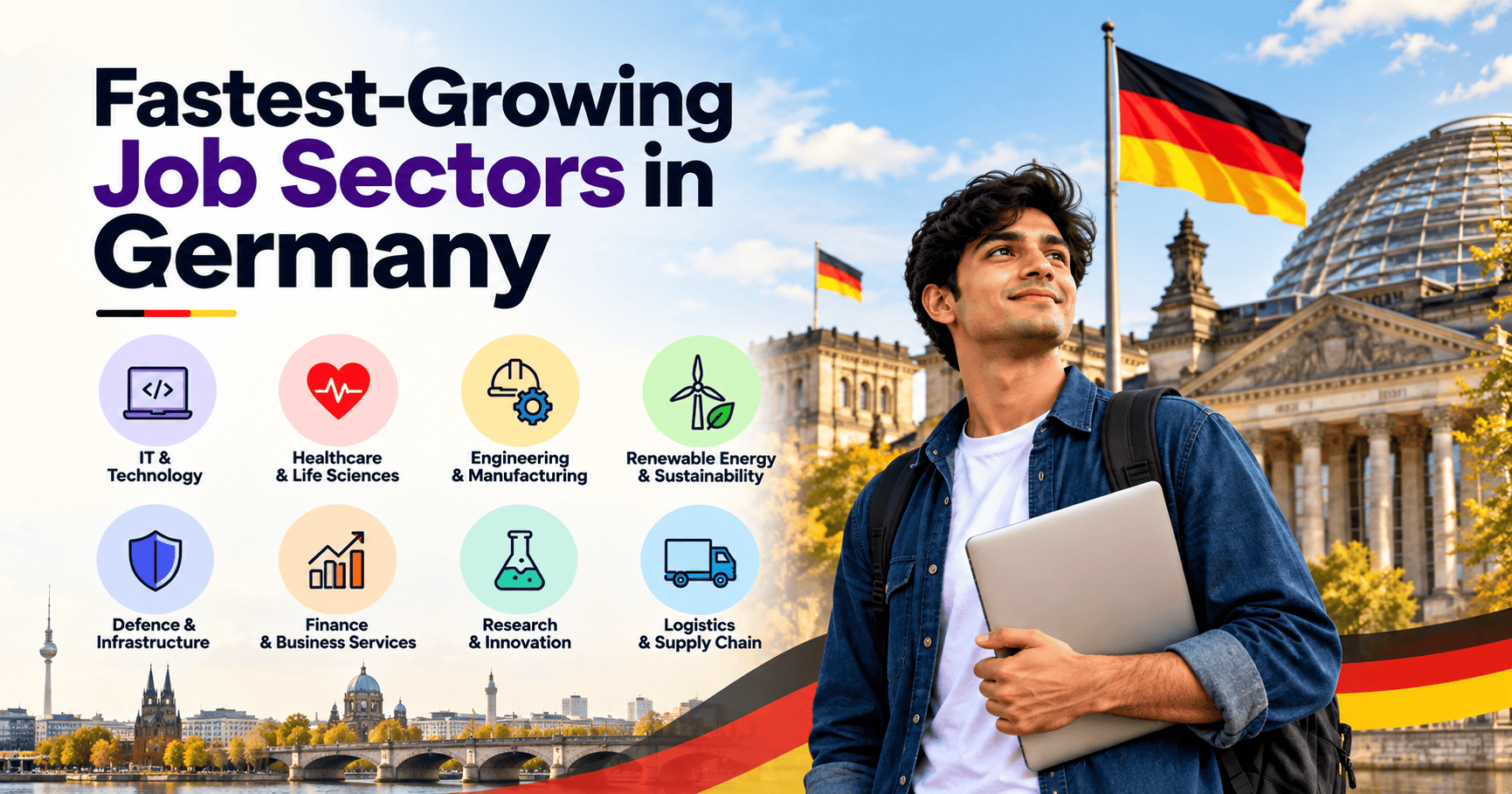
Germany’s job market in 2026 sends out mixed signals. Overall hiring has been sluggish for close to 2 years, yet the Federal Employment Agency (BA) still lists 163 occupations where employers cannot find enough qualified people. Economists also expect 2026 to be the first year in which more people leave the German workforce than enter it, which means the shortage is structural and will not fix itself when the economy picks up.
That contradiction is the reason your choice of sector matters more now than it did a few years ago. A degree in a field Germany is short of can lead to a job offer, an EU Blue Card and eventually permanent residence. A degree in a crowded field can leave you job hunting through most of your post-study window.
Indian students have clearly noticed the opportunity. Enrolment reached a record 69,816 in the winter semester 2025/26, a jump of 17.5% in a single year, and Indians are now the largest international student group in German universities. If you are planning for the 2027 intake, this guide covers where jobs are genuinely growing, what each sector expects from you and which rule changes you need to factor in before you apply.
Germany’s Fastest-Growing Job Sectors at a Glance
| Sector | Roles in demand | German language needed? |
| IT, AI and cybersecurity | Cloud, data engineering, security, applied AI | Helpful, often not essential |
| Healthcare and care | Nurses, doctors, health managers, medical informatics | Yes, B2 to C1 for clinical roles |
| Renewable energy and infrastructure | Electrical, grid, civil and energy engineers | Strongly preferred |
| Engineering, manufacturing and defence | Mechatronics, embedded systems, radar, automation | Preferred, varies by employer |
| Finance and fintech | Risk, compliance, data and quant roles | Helpful in Frankfurt, essential elsewhere |
| Logistics and supply chain | Procurement, supply chain analytics, planning | Preferred |
1. Information Technology, AI and Cybersecurity
Tech hiring in Germany cooled through 2025, and LinkedIn’s early 2026 labour market data still showed tech postings sitting well below their earlier peak. What has not cooled is demand for specific skills such as cybersecurity, cloud architecture, data engineering and applied AI, particularly inside manufacturers, banks and public bodies that are digitising late and now need to move quickly.
The bigger shift for students is where these jobs are located. Fewer openings now come from Berlin start-ups and more from industrial employers in Munich, Stuttgart and the Rhine-Ruhr region, where an IT profile backed by domain knowledge in automotive software, industrial IoT or energy systems stands out. IT specialists also qualify for the reduced EU Blue Card salary threshold of €45,934.20 in 2026.
2. Healthcare, Nursing and Elderly Care
Healthcare is the least cyclical sector on this list. Germany’s population is ageing fast, and hospitals, care homes and rehabilitation centres were short of staff even while other industries were trimming jobs. Indeed’s hiring outlook for 2026 expects job growth to concentrate in health and care, along with construction and defence.
The catch is language and recognition. Doctors need a German medical licence (Approbation) and usually a C1 medical German exam, while nurses must get their Indian qualification recognised, often after an adaptation period. Students who prefer an English-taught route tend to do well in public health, health management, biomedical engineering or medical informatics, which lead into hospital administration, health tech and pharma.
3. Renewable Energy and Infrastructure
Germany is legally committed to climate neutrality by 2045, and the bottleneck is no longer money but people. Grid operators, wind and solar developers, hydrogen projects and heat pump installers are all competing for the same pool of electrical and energy engineers. On top of that, the €500 billion infrastructure fund approved in 2025 is pushing money into railways, bridges, digital networks and energy grids over the next 12 years.
For students, this translates into demand for electrical engineering, energy systems, civil engineering and project management graduates. Many of these roles sit with mid-sized engineering firms and municipal utilities, so working-level German makes a noticeable difference to your shortlist.
4. Engineering, Manufacturing and Defence Technology
Germany’s car industry is going through a difficult transition, and several large suppliers have announced cuts. At the same time, rising defence spending has opened an entirely new hiring track. A study involving the Institute for Employment Research (IAB) estimates up to 200,000 new jobs could come from the defence build-up, and Rheinmetall was adding around 500 employees a month during 2025. In March 2026, sensor and radar maker Hensoldt announced roughly 1,600 new jobs in Germany, partly by recruiting engineers from shrinking automotive suppliers.
The practical lesson is to look beyond the big car brands. Mechanical, mechatronics, embedded systems and electrical engineering graduates are being pulled into aerospace, robotics, radar and industrial automation. Core defence roles can require security clearance that limits access for non-EU nationals, but supplier and civilian engineering roles around them are generally more open.
5. Finance and Fintech
Frankfurt remains the financial centre of continental Europe, home to the European Central Bank and a growing cluster of banks that relocated after Brexit. LinkedIn’s 2026 data showed financial sector hiring in Germany holding up better than most industries. The strongest demand is for regulatory compliance, risk management, data analytics and quantitative roles, especially where finance overlaps with technology. A master’s in finance, financial engineering or business analytics paired with programming skills is the profile recruiters respond to.
6. Logistics and Supply Chain Management
Germany’s position at the centre of Europe makes it a natural logistics hub, and the sector has become more strategic as companies rethink fragile supply chains. Defence and energy projects in particular need procurement specialists, supply chain analysts and planners who can manage long, complex sourcing. Graduates in supply chain management, operations research or industrial engineering with strong data skills fit these roles well, and logistics hubs around Hamburg, Duisburg and Frankfurt offer the most openings.
Rule Changes Indian Students Should Plan Around
- EU Blue Card 2026: the standard salary threshold is €50,700 a year, while shortage occupations and graduates within 3 years of finishing their degree qualify at €45,934.20.
- Job seeker permit: after graduation you can stay for up to 18 months to find work related to your degree.
- Blocked account: still €11,904 a year (€992 a month) for the student visa.
- APS 70% rule: bachelor’s applicants now generally need at least 70% in Class 12, applied from the winter semester 2026/27.
- dMAT for master’s applicants: from the summer semester 2027, selected Indian master’s applicants in certain subject areas must add a Digital Master Aptitude Test certificate to their APS file, so check whether your field is affected before you register.
Final Word
Germany is not hiring across the board in 2026, but it is hiring hard in specific places. Pick a course that maps onto one of these sectors, start learning German during your first semester rather than after it, and use internships to get a foot inside an employer before your degree ends. If you want help matching your profile to the right course and city, Dynamic Education Consultants can map it out with you in a single counselling session.
FAQs
01. Which job sector in Germany has the best prospects for Indian students in 2026-27?
Healthcare, energy and engineering roles linked to defence or infrastructure show the most consistent demand. IT remains strong for specialised skills like cybersecurity and cloud, though general software roles have become more competitive.
02. Can I get a job in Germany without speaking German?
In IT, research and some multinational engineering teams, yes. For healthcare, public sector, mid-sized firms and most customer-facing roles, B1 to C1 German is expected, so plan to learn it alongside your degree.
03. How long can I stay in Germany after completing my studies?
Graduates can apply for a residence permit of up to 18 months to look for work related to their qualification. Once you land a qualifying job, you can switch to an EU Blue Card or a skilled worker permit.
Recent Blogs




Book a Free Counselling Session with our Edu Buddies
"*" indicates required fields