Permanent Residency vs Citizenship: What’s the Difference?

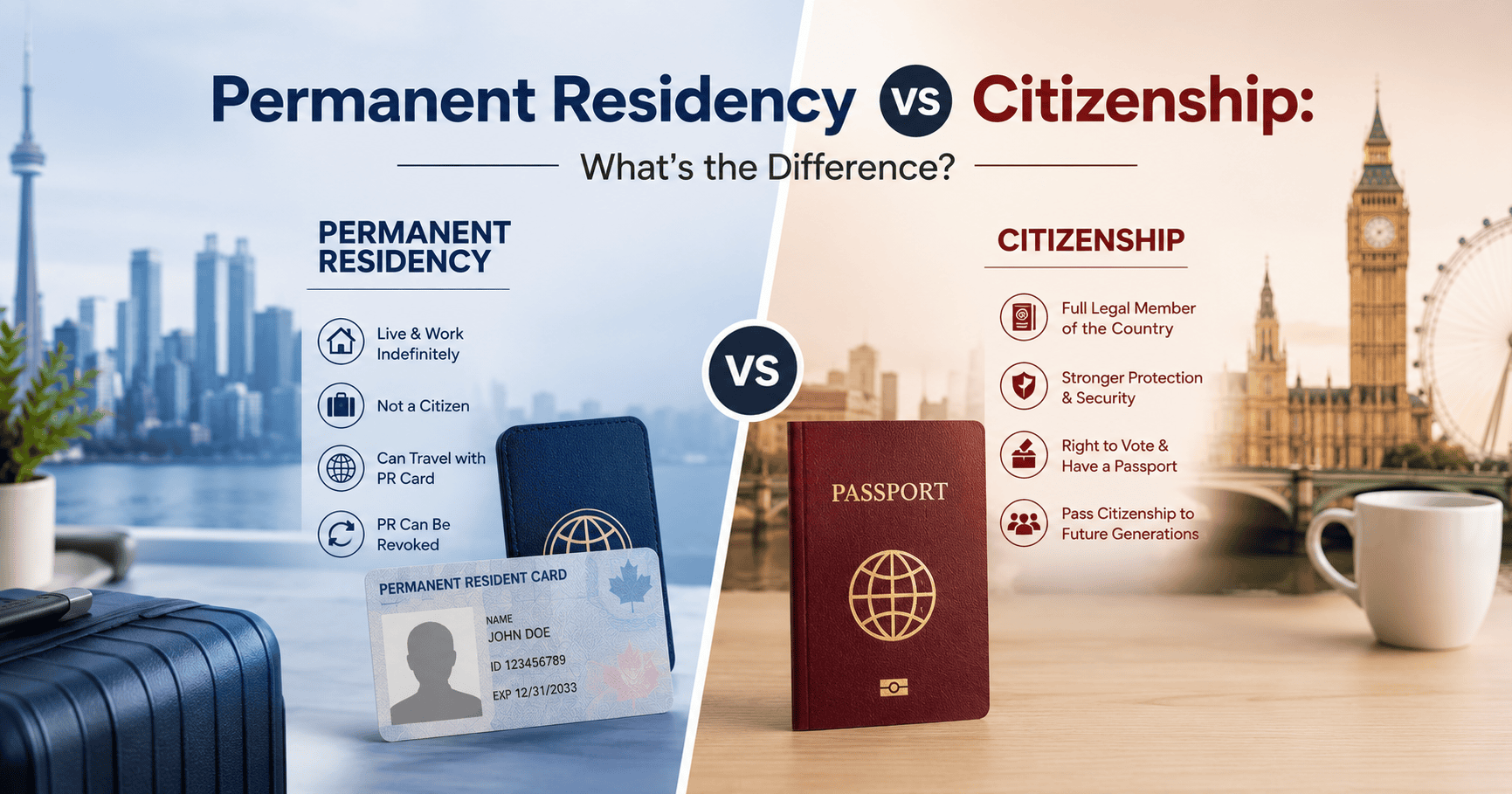
Confused about PR vs citizenship? Understand the difference between PR and citizenship, the benefits of each, voting and passport rights, and how to go from PR to citizenship.
What is the difference between PR and citizenship? In one line: permanent residency gives you the right to live and work in a country indefinitely, while citizenship makes you a full legal member of that country with a passport, voting rights, and protection from deportation.
A permanent resident still holds their original nationality. A citizen has changed it.
That distinction sounds small on paper. In practice, it shapes your taxes, your travel, your job options, and whether you can ever lose your status. Here is what actually separates the two.
What is permanent residency?
Permanent residency, often just called PR, is a legal immigration status that lets you stay in a foreign country indefinitely. You can work for almost any employer, buy property, access public healthcare and schooling in most countries, and travel in and out with your PR card.
The USA calls it a Green Card. Canada and Australia call it PR. The UK uses the term Indefinite Leave to Remain, and Germany calls it a Settlement Permit. Different names, similar idea.
Notice the word “permanent” is doing some heavy lifting, though. PR is renewable and conditional. Stay outside the country too long, break residency rules, or commit a serious crime, and it can be revoked. Your citizenship stays whatever it was before.
What is citizenship?
Citizenship is full legal membership of a country. You get its passport, you can vote, you can run for office, and you can apply for government or security-cleared jobs that residents are locked out of.
Most importantly, you cannot be deported. Citizenship, once granted, is effectively permanent. Governments can only revoke it in rare cases like fraud during the application, or if you renounce it voluntarily.
Citizenship is usually acquired by birth, by descent, or by naturalisation, which is the route most immigrants take after holding PR for a set number of years.
PR vs citizenship: the key differences
| Factor | Permanent Residency | Citizenship |
| Right to live and work | Yes, indefinitely | Yes, unconditionally |
| Passport | No, you keep your home country passport | Yes, with visa-free travel benefits |
| Voting rights | No national voting | Full voting rights |
| Government and defence jobs | Mostly restricted | Fully eligible |
| Risk of losing status | Yes, if rules are breached | Almost none |
| Time outside the country | Limited, must maintain residency | Unlimited |
| Sponsoring family | Limited to spouse and children | Broader, faster processing |
| Original nationality | Retained | Usually surrendered |
Which line matters most to you? For many people, it is the last one, especially Indian nationals, and we will come back to that.
Benefits of PR vs citizenship: which should you choose?
Let us be practical about this.
PR makes sense if you want to keep your Indian passport, plan to return home eventually, own property or a business in India, or simply do not need voting rights. PR gives you nearly all the day-to-day benefits of living abroad without cutting the legal tie to your home country. Many Indian professionals in Canada and Australia stay on PR for years for exactly this reason.
Citizenship makes sense if you have settled abroad for good, want the security of never worrying about status renewals, plan to travel frequently on a stronger passport, want to sponsor your parents or siblings, or want a career in government, defence, or roles requiring security clearance.
There is a middle path too. Get PR first, live there, then decide on citizenship later. You rarely have to choose on day one.
How does PR to citizenship actually work?
Naturalisation is the process, and every country sets its own clock. Here is roughly what the major destinations require after you hold PR.
| Country | Time needed before citizenship |
| Canada | 3 years of physical presence within a 5-year window |
| USA | 5 years as a Green Card holder, or 3 if married to a citizen |
| Australia | 4 years of lawful residence, including 1 year as a PR |
| UK | 5 years of residence plus 1 year holding ILR, so about 6 years |
| Germany | 5 years of residence, with faster routes for exceptional integration |
Most countries also ask for a citizenship test, a language test, a clean criminal record, and proof you have actually been living there rather than just holding the status.
Can Indians hold dual citizenship?
No, and this is the single biggest deciding factor for Indian applicants. The Constitution of India does not permit dual citizenship. The moment you become a citizen of another country, you automatically lose your Indian citizenship and must surrender your Indian passport.
So what happens to your ties with India? You can apply for an OCI card, or Overseas Citizen of India. An OCI gives you a lifelong multiple-entry visa to India, exemption from FRRO registration, parity with NRIs on financial and educational matters, and the right to work in the private sector and own property, though not agricultural land.
But be clear about what OCI is not. It is not dual citizenship. OCI holders cannot vote in India, hold public office, or work in government roles. The card can also be cancelled by the government under certain conditions. Think of it as a very generous lifelong visa rather than a second nationality.
So what is the right call?
There is no right answer, but here is a useful way to frame it. PR is about where you live. Citizenship is about where you belong legally.
If your life, family, and career are permanently rooted abroad, citizenship gives you security, mobility, and a political voice that PR never will. If you still see yourself moving between two countries, or you value keeping your Indian passport, PR delivers most of the practical benefits without the trade-off.
Take your time. PR first, citizenship later, is a perfectly sound plan.
Frequently Asked Questions
01. What is the main difference between PR and citizenship?
PR lets you live and work in a country indefinitely while keeping your original nationality. Citizenship makes you a full legal member with a passport, voting rights, and protection from deportation.
02. Is PR better than citizenship?
Neither is universally better. PR is better if you want to keep your home country passport and may return there. Citizenship is better for long-term security, visa-free travel, voting, and access to government jobs.
03. Can permanent residency be taken away?
Yes. PR can be revoked if you spend too long outside the country, breach residency conditions, obtain it through fraud, or commit serious crimes. Citizenship is far harder to lose.
04. How long does it take to go from PR to citizenship?
It varies by country. Canada requires 3 years of physical presence in a 5-year window, the USA requires 5 years as a Green Card holder, Australia requires 4 years of residence, and the UK requires around 6 years in total.
05. Do permanent residents pay the same taxes as citizens?
In most countries, yes. Permanent residents are generally taxed as residents on the same terms as citizens. Rules on foreign income differ by country, so check local tax law.
06. Does India allow dual citizenship?
No. India does not permit dual citizenship. Indians who take foreign citizenship lose their Indian citizenship but can apply for an OCI card, which functions as a lifelong visa without political rights.
07. Can permanent residents vote?
Not in national elections. A few countries allow permanent residents to vote in certain local or municipal elections, but national voting is reserved for citizens.




Book a Free Counselling Session with our Edu Buddies
"*" indicates required fields