Study Abroad After Graduation in India: Best Countries and Courses

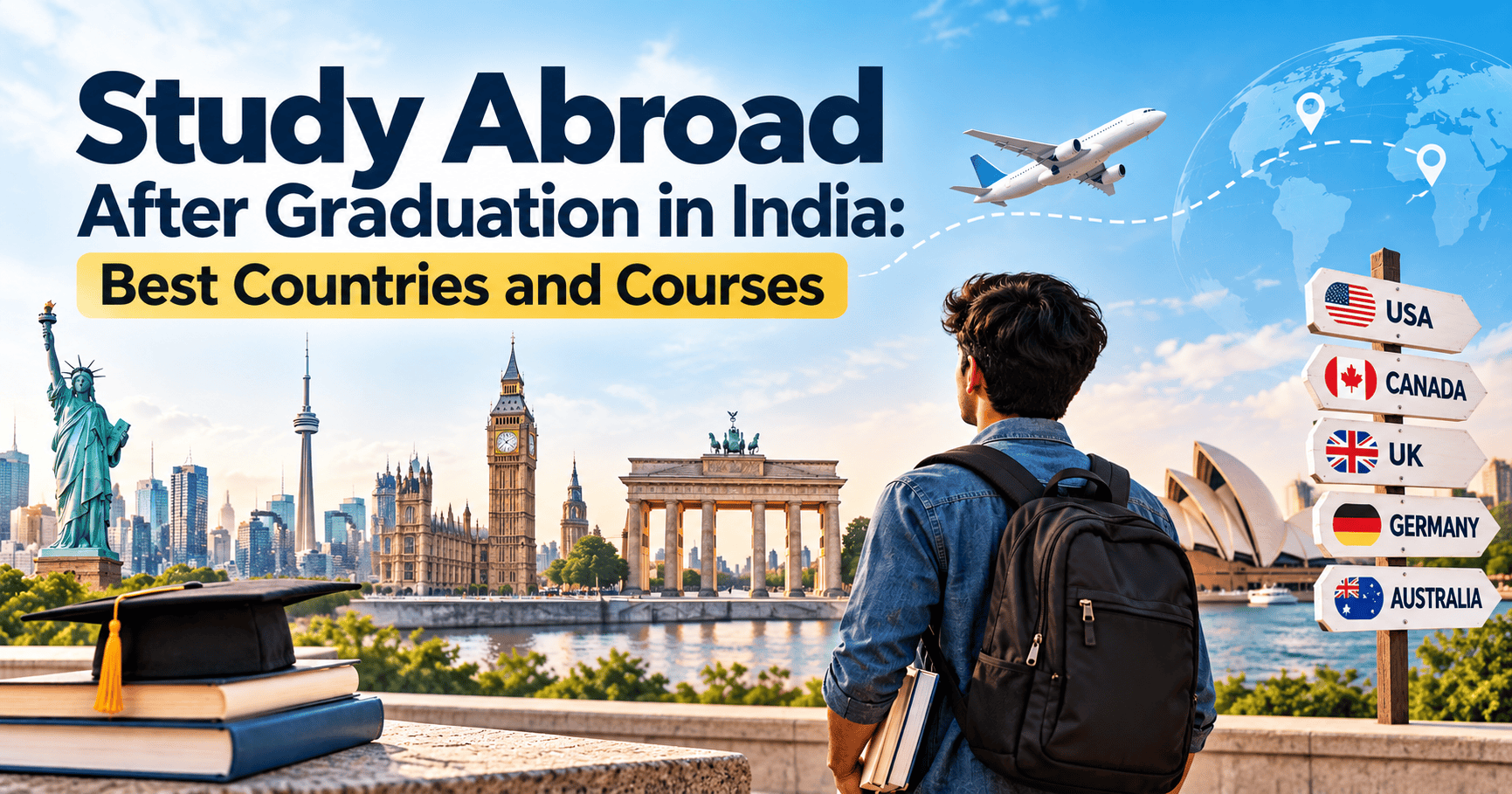
Planning to study abroad after graduation? Compare the best countries to study abroad, top courses, costs, and work visas for Indian graduates pursuing a master’s abroad.
Finished your bachelor’s and wondering what comes next?
Here is the short version: the best countries to study abroad after graduation for Indian students are the USA for tech and the highest salaries, Canada for permanent residency, the UK for one-year master’s degrees, Germany for near-zero tuition, and Australia and Ireland for strong work rights. On the course side, Data Science and AI, Computer Science, Business Analytics, Cybersecurity, and Healthcare lead on both demand and post-study visa eligibility.
But which combination is right for you? That depends on your budget, your degree background, and what you want your life to look like five years from now. Let us work through it.
Why study abroad after your bachelor’s?
A postgraduate degree abroad does three things an Indian master’s usually cannot. It gives you international work experience through post-study work visas. It plugs you into global hiring markets where salaries are several times higher. And in most cases, it opens a realistic pathway to permanent residency if you want one.
There is a timing advantage too. Applying right after graduation means your academics are fresh, references are easy to collect, and you have not yet built the commitments that make leaving harder later. That said, costs range from around Rs 10 lakh in Germany to over Rs 60 lakh in the USA, so the country you pick matters as much as the course.
Best countries to study abroad after graduation
USA: best for tech careers and salaries
The USA hosts the largest population of Indian students abroad, with over 3.6 lakh Indians enrolled in 2024-25. The draw is straightforward. Post-study employment sits around 85 to 90 percent within six months of graduation for STEM graduates, and STEM programs qualify for up to 36 months of OPT without needing employer sponsorship upfront.
The catch is cost, usually Rs 40 to 65 lakh for a two-year master’s, and the H-1B lottery if you want to stay long term.
Canada: best for PR
Why do so many Indian graduates choose Canada? The Post-Graduation Work Permit gives you up to three years of work rights, and that Canadian experience feeds directly into Express Entry for PR. No lottery, no sponsorship requirement.
Costs are moderate at roughly Rs 20 to 35 lakh, and Toronto, Montreal, and Vancouver have become genuine AI and fintech hubs.
UK: best for a fast master’s
Most UK master’s programs finish in a single year. That halves your tuition and gets you back into the job market twelve months sooner than a US graduate. The Graduate Route visa then gives you two years to work without needing sponsorship.
Expect around Rs 25 to 40 lakh all in. It suits students who want a respected global degree without a two-year commitment.
Germany: best affordable option
Public universities in Germany charge little to no tuition, so total costs can stay near Rs 10 to 15 lakh including living expenses. Add an 18-month job-seeker visa and an EU Blue Card route to PR, and it becomes the strongest value destination available. Engineering and computer science students in particular are underusing it. Most programs teach in English, though learning German widens your job market considerably.
Australia and Ireland: strong middle ground
Australia offers 2 to 4 years of post-study work rights and a points-based PR system, with particular strength in healthcare, nursing, and STEM. Ireland has quietly become a favourite for tech and pharma, thanks to a 2-year stay-back visa and the European headquarters of Google, Meta, and Pfizer sitting in Dublin.
Quick comparison of study abroad options for Indian students
| Country | Duration | Total cost (approx) | Post-study work | Best for |
| USA | 2 years | Rs 40-65 lakh | Up to 3 yrs OPT (STEM) | Tech, research, salaries |
| Canada | 1-2 years | Rs 20-35 lakh | Up to 3 yrs PGWP | PR and settlement |
| UK | 1 year | Rs 25-40 lakh | 2 yrs Graduate Route | Speed and brand value |
| Germany | 2 years | Rs 10-15 lakh | 18-month job seeker visa | Affordability, engineering |
| Australia | 2 years | Rs 25-40 lakh | 2-4 years | Healthcare, STEM, PR |
| Ireland | 1-2 years | Rs 20-30 lakh | 2 years | Tech and pharma roles |
Best courses to study abroad after graduation
Which course should you pick? Choose based on employer demand and visa eligibility, not just interest.
1. Data Science, AI and Machine Learning. Consistently the highest-demand postgraduate field globally. Finance, healthcare, retail, and manufacturing all run on data pipelines now. Strong options at MIT, Stanford, Carnegie Mellon, and across Canadian and German universities.
2. Computer Science and Software Engineering. The safest broad choice for engineering graduates, with STEM designation in the USA and skilled-occupation status in Canada and Australia.
3. Cybersecurity. A global talent shortage means graduates are hired fast. It appears on the skilled occupation lists of most major destinations.
4. Business Analytics and MBA. Best suited to commerce and business graduates. Analytics programs often qualify as STEM in the USA, which is a meaningful visa advantage over a traditional MBA.
5. Healthcare and Nursing. Australia, Canada, and the UK all face shortages here, and these courses often come with the clearest PR pathways of any field.
6. Renewable Energy and Sustainability. A newer field growing fast across Europe, and a good fit for mechanical, civil, and environmental engineering graduates.
What do you need to apply?
Most master’s programs abroad ask for a bachelor’s degree with 60 to 70 percent or a GPA equivalent, IELTS or TOEFL scores, and GRE or GMAT for some universities, though waivers are increasingly common. You will also need an SOP, two or three letters of recommendation, and proof of funds for your visa.
Start 9 to 12 months before your intended intake. For a September 2027 start, that means beginning tests and shortlisting by late 2026.
So how should you decide?
Work backwards from your goal. Want the highest salary and a tech career? USA. Want to settle abroad permanently? Canada or Australia. Working with a limited budget? Germany, easily. Want to finish quickly and start earning? UK or Ireland.
One last thing. A cheaper degree that leads to real work experience beats an expensive one that sends you home without it. Pick the country whose job market you can realistically enter, not just the best-known name.
Frequently Asked Questions.
1. Which is the best country to study abroad after graduation for Indian students?
It depends on your goal. The USA leads for tech careers and salaries, Canada for PR, the UK for one-year master’s programs, and Germany for affordability with near-zero tuition at public universities.
2. Which course is best to study abroad after graduation?
Data Science and AI, Computer Science, Cybersecurity, Business Analytics, and Healthcare rank highest on employer demand, salary, and post-study work visa eligibility.
3. What is the cheapest country to study abroad after graduation?
Germany. Public universities charge little to no tuition, keeping total costs around Rs 10 to 15 lakh. Norway, France, and Poland are also low-cost options.
4. Can I study abroad after graduation without IELTS?
Some universities waive IELTS if your bachelor’s was taught in English or if you have a strong English score in Class 12. Policies vary widely, so confirm with each university.
5. Is GRE required for a master’s abroad?
Not always. Many universities in Canada, Germany, the UK, and Australia do not require it, and several US universities now offer waivers based on academics or work experience.
6. How much does it cost to do a master’s abroad?
Roughly Rs 10 to 15 lakh in Germany, Rs 20 to 35 lakh in Canada, Rs 25 to 40 lakh in the UK and Australia, and Rs 40 to 65 lakh in the USA, including living expenses.
7. Should I work first or study abroad right after graduation?
For technical master’s programs, applying directly after graduation works well. For an MBA or management degree, most top schools expect 2 to 5 years of work experience first.
Recent Blogs



Book a Free Counselling Session with our Edu Buddies
"*" indicates required fields